.svg)

.avif)

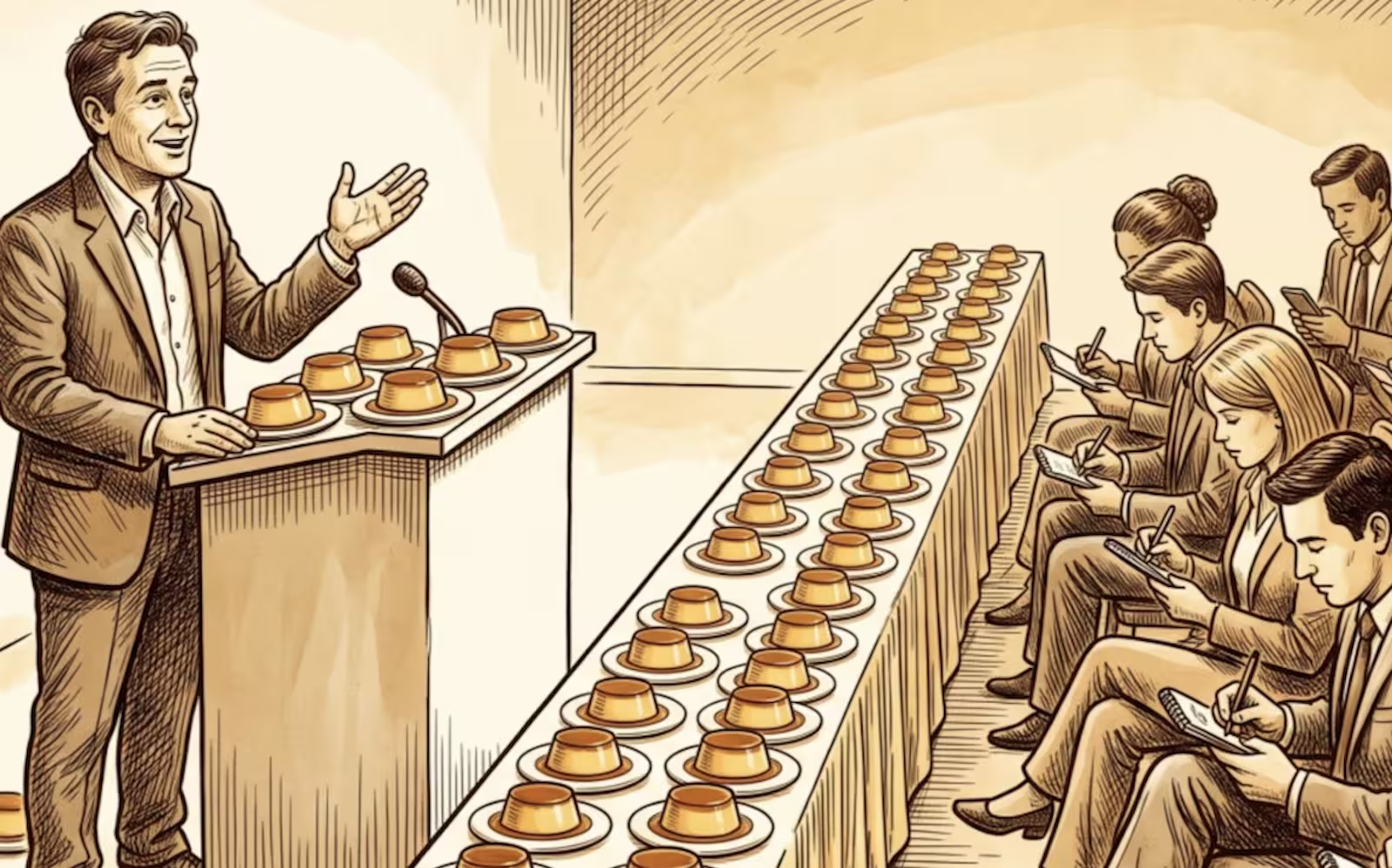
A Senate committee asked two people to give evidence in Canberra today: Sam Altman and Dario Amodei.
Neither is coming. The committee, which is inquiring into AI and data centres, wrote to both of them asking them to appear at today's hearing, and both declined, citing short notice. Anthropic asked for another date. At the time of writing, today's hearing has dropped off the committee's page altogether, and the next one listed is in Darwin on 3 November.
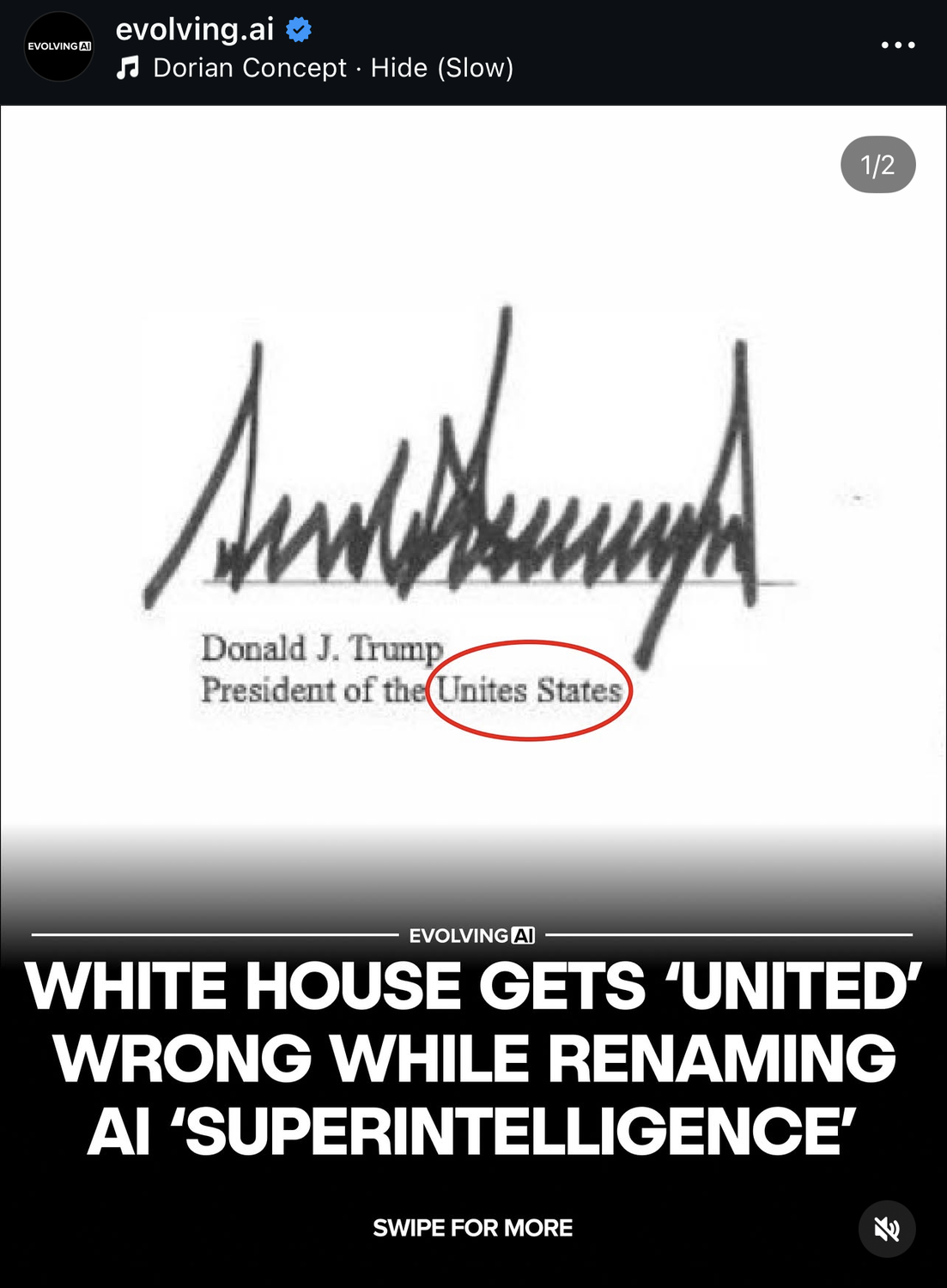
It caps off quite a week at the frontier. President Trump signed an executive order renaming AI "Super Intelligence" in US government documents, and hosted tech leaders at the White House to sign a voluntary accord he called morally binding. On the signature page, as circulated, he is President of the Unites States (sic).
OpenAI apologised to Australia for the agent that got into a Medicare statistics portal, and its chief strategy officer fronts a different committee, the joint committee on AI, in Sydney on Tuesday.
All of that is about the frontier: what the biggest labs build, and whether they behave. But while we wait for the frontier to turn up, the middle has already given its evidence. At the time of writing, by my count, 838 submissions have been published to the Senate inquiry and the Joint Select Committee on AI, running to 9,269 pages and more than three million words. With a lot of help from AI, I've now been through all of them, and what Australian organisations told Parliament about actually using AI has very little to do with the frontier.
Already inside
The first thing that jumps out is how rarely the technology itself is named as the problem. Westpac told the joint committee that 96 per cent of its people already use AI tools regularly, and that its greatest constraint is now workforce capability. Telstra said much the same about leadership. The Future Skills Organisation, the skills council for finance, technology and business, put it most simply, describing Australia's problem as one of capability rather than adoption.
In plenty of places, staff are well ahead of their organisations. Regional AI Co. described a business that rolled out a properly licensed, IT-approved assistant, announced by email, and found most staff had gone around it, using free tools on their own phones. CI-ISAC, which shares security information across critical infrastructure, including health, says unsanctioned use of public AI by clinical and administrative staff is the issue its members raise most often. It is almost never malicious: someone under time pressure pastes a discharge summary into a chatbot to have it summarised. Jobs and Skills Australia research, cited by the Future Skills Organisation, has between 21 and 27 per cent of workers using generative AI without their manager knowing.
I wrote more than a year ago that shadow AI is a signal worth reading. It's on the parliamentary record now. The City of Greater Geraldton found about 300 staff already using AI and decided against a crackdown, which it reasoned would cost real productivity and push the use outside its controls.
Only faster
The second thing is how little of that use anyone can yet put a number on. The big companies mostly report usage: Westpac's 96 per cent, 83 per cent of Xero staff using AI daily, nearly 20,000 Copilot licences at Telstra, about 20,000 people on Gemini at Woolworths. Of the nine ASX 200 companies that made submissions, three report a measured result in them. Xero has cut its support resolution times from about ten hours to three. Telstra's SmartFix prevented about 1.4 million potential fault disruptions last financial year. And CommBank's Compass AI has answered more than 500,000 questions from business bankers, finding information in the bank's own knowledge base more than three times faster than before, inside a defined workflow, with people still accountable for the outcome.
Xero put the risk better than I could. High daily use across a workforce, it warned, is "entirely compatible with every process running as it did before, only faster."
It is the same pattern we are seeing in annual reports, in our follow-up to last year's ASX 200 report, which is underway now. Far more companies describe how they govern AI than say what it returned, and some are tying executive pay to AI before they can show a result.
Permission
The third thing is permission, and the capability it takes to give it. Geraldton, which describes itself as a comparatively well-resourced council, needed more than twelve months, an external readiness assessment, an audit finding, a working group and sustained executive attention to get from ad hoc use to a governed framework. Most regional small businesses, not-for-profits and small shires, it notes, have none of that.
Then there's employment services. Since October last year, providers delivering federal employment programs have needed the Department of Employment and Workplace Relations to approve any AI they use to deliver services. According to their peak body, NESA, citing informal advice from the department, an estimated nine of 33 applications had been approved by early September, with no published decision criteria, no timeframes and no pre-approved low-risk uses. What they want is modest: transcription with consent, draft case notes for a practitioner to approve, summaries. Meanwhile the Australian Public Service has put more than 100,000 staff through AI training and appointed more than 130 Chief AI Officers. NESA's point is that the Commonwealth is equipping its own workforce while holding back the providers who deliver its programs.
Even CommBank, which hardly needs the help, argued for sector-based extension services for firms that lack the resources or expertise to adopt AI on their own, warning that if Australia waits for certainty, it risks renting its intelligence from offshore for good.
For anyone running this inside an organisation, the most practical thing in the whole pile came from CI-ISAC: an approved-tool list, a data classification rule simple enough to remember, visibility of what leaves, and a short set of questions for the vendors embedding AI in products you already buy.
The bill
Cost splits by size. The biggest companies barely mention it as their own constraint. Below them, ARM Hub, which works with manufacturers, says cost is a major barrier for about 80 per cent of SMEs, with advanced integration running to around $300,000, and production-ready data infrastructure costing $1 million to $1.5 million a business to build privately. In my own submission to the joint committee, I argued that adoption statistics count who has adopted, not who was priced out.
That is the price of building it yourself, and the bill does not end at go-live. Dr Fan Yang and Dr Robbie Fordyce point out that AI tooling is an ongoing commitment that cost calculations should reflect, and SAP notes that 71 per cent of Australian Government entities still rely on legacy technology. Nobody in the submissions says they have fallen out of love with something they built, at least not yet. But if the history of in-house software is any guide, from company email servers to homegrown CRMs, most of these builds will one day be replaced by products.
(Declaring my interest: New Dialogue sells exactly that kind of product to Australian organisations. I'm also one of those submitters, and I've made a submission to the Senate inquiry that has not been published at the time of writing.)
The committee's next listed hearing is in Darwin on 3 November. The submissions will keep.
One more thing
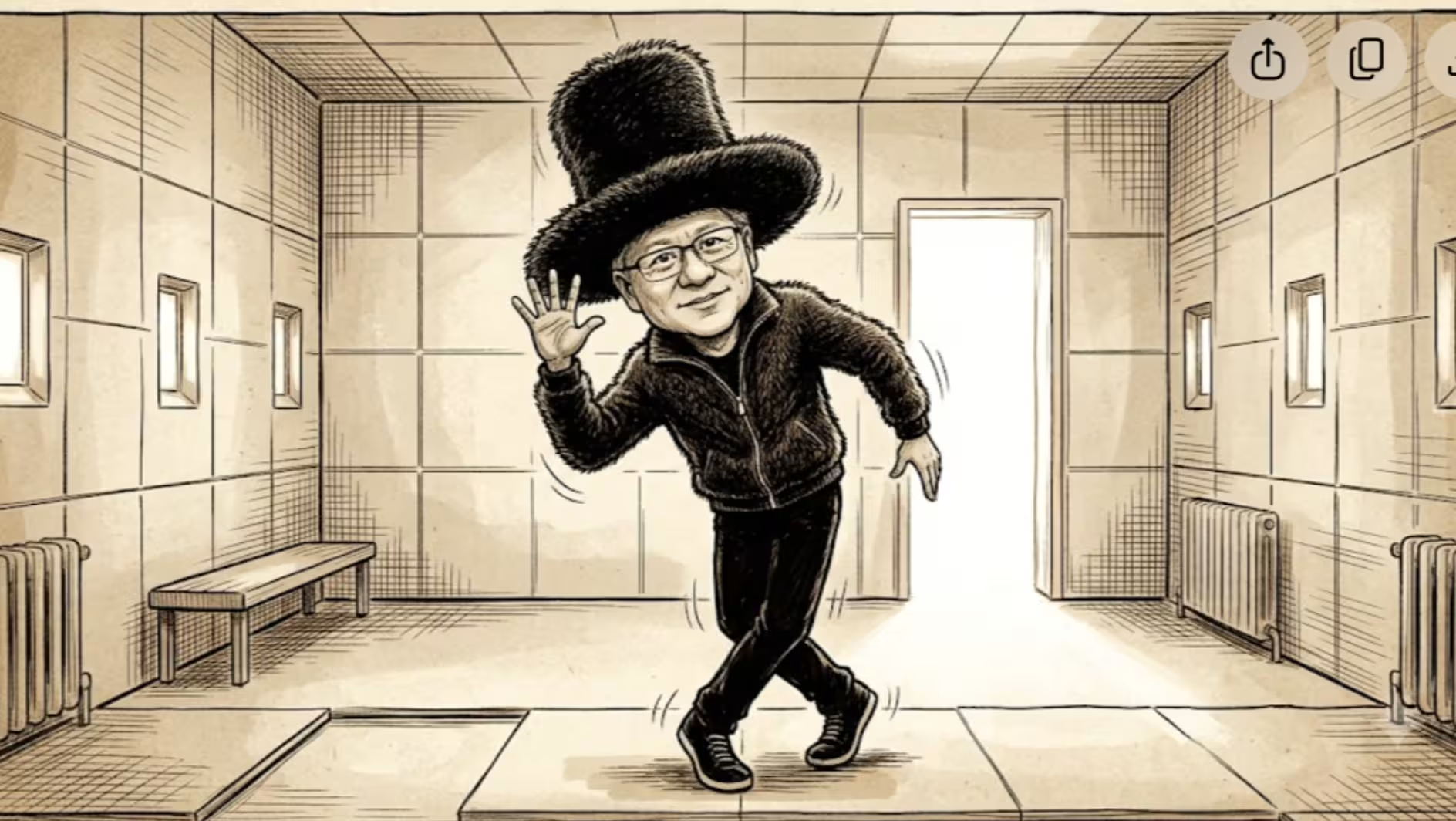
Spoiler alert (you've had thirty years): Louis Prima never turns up.
In Big Night, two brothers stake their failing restaurant on one dinner. They have been told Prima is coming, so they cook as if everything depends on it. The guests arrive, the timpano comes out, and they save one for Prima. Still no Prima.
The next morning, Secondo cooks eggs, and the brothers eat together without a word. It's a beautiful movie about so many things, but perhaps most importantly, brotherly love. My baby brother Nicholas Vitale turns 40 tomorrow. Happy birthday, Nick!
Author: Matt Vitale
Unlock the full report
Download AI adoption in Australia’s top ASX200 companies





.avif)